
Patellofemoral Knee Replacement in Bountiful and Layton, UT
Patellofemoral knee replacement is a partial knee replacement procedure designed to treat arthritis limited to the area where the kneecap meets the femur. Unlike total knee replacement, this approach can preserve healthy portions of the knee and the ACL and PCL when appropriate. Robotic-assisted planning may also be used to help customize implant positioning based on the patient's knee anatomy.
Dr. Hickman evaluates the location and severity of arthritis, symptoms, imaging findings, knee stability, and previous treatments to determine whether patellofemoral knee replacement is appropriate. Patients seeking patellofemoral knee replacement in Bountiful or Layton, UT, can schedule an orthopedic consultation to discuss their condition and treatment options.
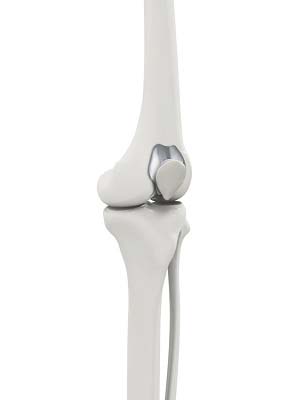
What is Patellofemoral Knee Replacement?
Traditionally, a patient with only one compartment of knee arthritis would undergo a total knee replacement surgery. Patellofemoral knee replacement is a minimally invasive surgical option that preserves the knee parts not damaged by arthritis as well as the stabilizing anterior and posterior cruciate ligaments, ACL and PCL.
The smaller implants used with a partial knee replacement surgery are customized to your anatomy based upon CT scans of your knee. A surgical robotic arm assists your surgeon with pre-operative planning and intraoperative component placement, positioning, and alignment. Patellofemoral knee arthroplasty surgery will not alter the ability of the patient to eventually move to a total knee replacement in the future should that become necessary.
Indications of Patellofemoral Knee Replacement
Patellofemoral knee replacement surgery may be recommended by your surgeon if you have osteoarthritis contained to the patellofemoral compartment and you have not obtained adequate relief with conservative treatment options. This less invasive bone and ligament preserving surgery is especially useful for younger, more active patients as the implant placed more closely mimics actual knee mechanics than does a total knee surgery.
Patellofemoral Knee Replacement Procedure
Partial Knee Replacement surgery is performed in an operating room under sterile conditions with the patient under general anesthesia or spinal anesthesia with sedation. It is usually performed on an outpatient basis as day surgery.
- Your surgeon makes a small incision, about 3-4 inches long over the knee.
- With the assistance of the robotic arm, the patellofemoral compartment is prepared for the artificial components by removing the damaged part of the patella and trochlea, the groove at the end of the femur.
- The new artificial components are fixed in place with the use of bone cement.
- The femoral component is made of polished metal and the patellar component looks like a plastic button which will glide smoothly in a groove located on the femoral component.
- With the new components in place, the knee is taken through a range of movements.
- Once the surgeon is satisfied with the results, the arthroscope and surgical instruments are removed and the incisions covered with a sterile dressing or biologic glue.
Postoperative Recovery after Patellofemoral Knee Replacement
Common post-operative guidelines include:
- You will be taken to the recovery room and monitored for any complications.
- You will be given pain medication to keep you comfortable at home.
- You will need someone to drive you home due to the drowsy effects of the anesthesia.
- Swelling is normal after knee surgery. Ice, compression, and elevation of the knee will be used to minimize swelling and pain.
- You will be given specific instructions regarding activity. Usually there are few activity restrictions.
- You will be referred to a rehabilitation program for exercise and strengthening.
- Eating a healthy diet and not smoking will promote healing.
Risks and Complications of Patellofemoral Knee Replacement
As with any major surgery there are potential risks involved. The decision to proceed with the surgery is made because the advantages of surgery outweigh the potential disadvantages.
It is important that you are informed of these risks before the surgery takes place.
Complications can be medical (general) or specific to knee surgery. Medical complications include those of the anesthetic and your general wellbeing. Almost any medical condition can occur so this list is not complete. Complications include:
- Allergic reactions to medications
- Blood loss requiring transfusion with its low risk of disease transmission
- Heart attacks, strokes, kidney failure, pneumonia, bladder infections
- Complications from nerve blocks such as infection or nerve damage
- Serious medical problems can lead to ongoing health concerns, prolonged hospitalization, or rarely death.
Complications are rare after knee surgery, but unexpected events can follow any operation. Your surgeon feels that you should be aware of complications that may take place so that your decision to proceed with this operation is taken with all relevant information available to you.
Specific complications related to patellofemoral knee replacement surgery include:
- Infection : Infection can occur with any operation. In the knee this can be superficial or deep. Infection rates are approximately 1%. If it occurs, it can be treated with antibiotics, but may require further surgery.
- Deep vein thrombosis : DVT are blood clots that can form in the calf muscles and travel to the lung (pulmonary embolism). These can occasionally be serious and even life- threatening. If you get calf pain or shortness of breath at any stage, you should notify your surgeon.
- Ligament injuries: There are several ligaments surrounding the knee. These ligaments can be torn during surgery or break or stretch out any time afterwards. Surgery may be required to correct this problem.
- Injury to blood vessels or nerves: Rare, but can lead to weakness and loss of sensation in part of the leg. Damage to blood vessels may require further surgery if bleeding is ongoing.
- Arthrofibrosis: This is the development of thick, fibrous material around the joint that often occurs after joint injury or surgery and can lead to joint stiffness and decreased movement.
- Wearing out: The components eventually wear out over time, usually 10 to 15 years, and may need to be changed.
- Dislocation: An extremely rare condition where the ends of the knee joint lose contact with each other.
- Fractures or breaks: Can occur during surgery or afterwards if you fall. To fix these, you may require surgery.
Risk factors that can negatively affect adequate healing after knee arthroscopy include:
- Poor nutrition
- Smoking
- Obesity
- Age (over 60)
- Alcoholism
- Chronic Illness
- Steroid Use
Why Choose Dr. Joshua Hickman for Patellofemoral Knee Replacement in Bountiful and Layton, UT
- Specialized Knee Replacement Care: Dr. Hickman provides orthopedic care for patients with knee arthritis and conditions affecting the patellofemoral joint.
- Partial Knee Replacement Approach: Patellofemoral replacement addresses the damaged compartment while preserving healthy areas of the knee when appropriate.
- Robotic-Assisted Planning: When indicated, advanced technology can assist with preoperative planning and component positioning based on the patient's individual knee anatomy.
- Individualized Treatment: Your symptoms, imaging, knee stability, activity level, and overall joint health are considered when determining whether patellofemoral replacement is appropriate.
- Convenient Northern Utah Locations: Patients can access specialized knee care in Bountiful and Layton, serving communities throughout Northern Utah.
Patellofemoral Knee Replacement FAQs
What is patellofemoral knee replacement?
Patellofemoral knee replacement is a type of partial knee replacement that replaces the damaged surfaces of the patellofemoral compartment, where the kneecap moves against the groove at the end of the thighbone.
Who may be a candidate for patellofemoral knee replacement?
Patients with arthritis primarily confined to the patellofemoral compartment may be candidates when nonsurgical treatments have not provided adequate relief. The other compartments and supporting structures of the knee must also be evaluated before surgery is recommended.
How is patellofemoral replacement different from total knee replacement?
Total knee replacement addresses damaged surfaces throughout the knee. Patellofemoral replacement focuses only on the damaged patellofemoral compartment, potentially preserving healthy bone, cartilage, and other knee structures.
What symptoms can patellofemoral arthritis cause?
Patellofemoral arthritis can cause pain at the front of the knee, particularly with activities such as climbing stairs, squatting, kneeling, or getting up from a seated position. Stiffness, swelling, and grinding or clicking may also occur.
What causes patellofemoral arthritis?
Patellofemoral arthritis may develop from cartilage wear and tear, previous injury, abnormal kneecap tracking, or other factors affecting the mechanics of the joint. An orthopedic evaluation can help identify the cause of your symptoms.
Is patellofemoral knee replacement minimally invasive?
Patellofemoral replacement generally uses a smaller surgical approach than a traditional total knee replacement, although the exact technique and incision vary based on the patient's anatomy and surgical needs.
Can robotic technology be used for patellofemoral knee replacement?
Robotic-assisted technology may be used to support preoperative planning and component positioning in appropriately selected patients. The surgeon remains responsible for performing the procedure and making surgical decisions.
Can I still have a total knee replacement later?
Patellofemoral replacement does not necessarily prevent a patient from undergoing total knee replacement in the future if arthritis develops in other compartments or additional joint damage occurs. Your surgeon can discuss how your individual circumstances may affect future treatment options.
What is recovery like after patellofemoral knee replacement?
Recovery varies among patients. Many patients participate in rehabilitation exercises designed to restore knee motion, strength, and function. Your surgeon will provide specific instructions regarding walking, exercise, and returning to daily activities.
What are the risks of patellofemoral knee replacement?
Potential risks include infection, blood clots, stiffness, nerve or blood vessel injury, ligament injury, fracture, implant wear, and the possibility of additional surgery. Your surgeon will discuss the potential risks and benefits before treatment.
How long does a patellofemoral knee replacement last?
The lifespan of a knee implant varies based on factors such as activity level, overall health, implant characteristics, and individual circumstances. Your surgeon can discuss expected implant longevity and ways to protect your knee replacement.
Where can I receive patellofemoral knee replacement in Northern Utah?
Dr. Joshua Hickman provides consultations for patellofemoral knee replacement in Bountiful and Layton, UT, serving patients from surrounding Northern Utah communities.
Explore Patellofemoral Knee Replacement in Bountiful and Layton, UT
Dr. Joshua Hickman provides individualized evaluations for patients in all of the intermountain west and Utah including Bountiful, Layton, and surrounding Northern Utah communities. Schedule a consultation to discuss your symptoms, review your imaging, and determine whether patellofemoral knee replacement may be appropriate for you.
Schedule a Patellofemoral Knee Replacement Consultation in Bountiful or Layton, UT Today.
Related Topics:
- Knee Arthroscopy
- Unicompartmental Knee Replacement
- Minimally Invasive Knee Replacement
- Patellofemoral Knee Replacement
- What is New in Knee Replacement
- Computer Navigation for Total Knee Replacement
- Total Knee Replacement
- Custom Knee Replacement Surgery
- Revision Knee Replacement
- Robotic Assisted Partial Knee Surgery
- Mako Robotic Knee Replacement
- Signature Knees
- Custom-fitted Total Knee Arthroplasty
- Partial Knee Resurfacing
- High Tibial Osteotomy
- Tibial Tubercle Osteotomy
- ACL Reconstruction
- Outpatient Total Knee Replacement
- Tricompartmental Knee Replacement
- After Knee Replacement
- Knee Implants
- Autologous Chondrocyte Implantation
- Partial Meniscectomy
- Meniscal Surgery
- Partial Knee Replacement
- Pharmacological
- Platelet Rich Plasma
- Viscosupplementation
- Cortisone Injection
- Physical Therapy